Issue 18 - Wicked: For Real
A reality check on some of policycraft's most familiar memes
WELCOME
Policycraft is built on the conviction that policymaking is a profession worth treating as one. Like every profession, it accumulates a vocabulary: doctors have theirs, lawyers have theirs, and policy wonks have ours. While acquiring the terms of art is part of how you become a member in good standing, the trouble with our vocabulary is that it tends to sound more rigorous than it is. “Wicked problem” gets invoked the way “systems thinking” or “evidence-based” get invoked, as shorthand that signals you’re taking the problem seriously without committing yourself to defining what makes it serious. We complain about low “policy capacity” without saying capacity for what, in whom, at what level; we’re missing something but struggle to articulate how to find it again. We write 100-page reports filled with everything we need to say but it’s a meme that says what elected officials need to hear.
Consider this month’s issue an exercise in slowing down and thinking again. What is a “wicked problem”? What is policy capacity and how do we know when we have it (or don’t)? What good are all those reports we produce? Is the posting-to-policy pipeline real? And why can’t everyone “just”…?
THIS MONTH’S SYLLABUS
🎓 “Policy capacity: A conceptual framework for understanding policy competences and capabilities” by X Wu, M Ramesh, and M Howlett, Policy and Society
The precursor to Policycraft was a community of practice I built in government, and the impetus for that was a concern about policy capacity across Canadian government. We, rightly, talk a lot about state capacity. I’m interested in a component of that: the skills needed to design and decide on successful policies. This article is a good level-set on what public policy capacity is, as Wu, Ramesh, and Howlett theorize a matrix of nine sub-capacities, where three competences (analytical, operational, political) intersect with three resource levels (individual, organizational, systemic). The useful provocation embedded in the framework is that most policy failures emerge from imbalances across these cells: one or two capacities get all the attention while others starve.
A question for you, reader: How would we assess Canada’s current policy capacity? The last major academic surveys are from 15 years ago, but in 1996 the federal government commissioned research on the subject that unfortunately contains some chillingly prescient lines: “[The author] observes that at a time when there is a pressing need for governments to make departures from the status quo and to consider longer-term, strategic choices, a number of conflicting factors in the environment tend to inhibit them from doing so… He concludes with a warning that the ability of governments to deal with the increasing complexity of policy issues has been threatened by a decline in the importance attached to the public service’s policy role and the loss of a generation of trained policy analysts from government.”
📚 Inside Public-Sector Innovation: How Local Governments Put Ideas into Action by Zachary Spicer, Joseph Lyons, and Tyler Romualdi
I’m a huge booster of the idea that not only do municipalities do policy work, they are capable of delivering some of the most important and innovative policy work. I was so happy to see I’m not alone in this thinking, thanks to Spicer, Lyons, and Romualdi’s new book. What I particularly love about this publication is that they enlisted actual public servants to write their own case studies, sharing tactical insight into how and why they innovated in their governments and communities. The 17 cases span changes to organizations, processes, and services across municipalities of every shape and size, from the District of Squamish to the City of Toronto, organized into three thematic sections. The editors then bookend the cases with practical synthesis on the commonalities and lessons that emerge across them all. My personal favourites were about the innovation teams in Durham and York regions, the pushback against our increasingly low trust society by the Hamilton Public Library, and the forward-looking utilities governance in Richmond.
🎓 “What is so wicked about wicked problems? A conceptual analysis and a research program” by B Guy Peters, Policy and Society
Are ‘wicked’ problems all that wicked? 🔥Policycraft‘s Hot Take of the Month (Academic Edition)🔥 pushes back on how over-used that phrase is and posits that wickedness is about more than just complexity. Peters (also the author of the 1996 policy capacity report linked above) argues the concept has become a fad in contemporary policy analysis, with all manner of difficult problems labelled “wicked” regardless of whether they meet the original criteria laid out by Rittel and Webber back in 1973 (no definitive formulation of the problem, no stopping rule for solutions, novel rather than recurring, irreversible consequences, and so on). His proposed research program tests, empirically, whether problems we routinely call ‘wicked’ actually demonstrate the full set of attributes, or whether they are simply hard. The implication for practitioners: calling everything wicked obscures useful distinctions among problem types and steers us toward one-size-fits-all solutions, when in fact more tailored approaches are usually available.
Want to read more about wicked problems? Here’s a typology from John Alford and Brian Head with thoughts on how to solve particular kinds, complete with a contingency framework that matches a collaboration approach to problem type.
💻 “Death to the policy report” by Todd Moss, Eat More Electrons
Now for 🔥Policycraft’s Hot Take of the Month (Practitioner Edition)🔥, care of energy and poverty wonk Todd Moss, who says what we’re all thinking: do those massive reports we produce actually get read and, even more critically, do they actually effect change? Moss has the credentials to make the case, having worked at the World Bank and as U.S. Deputy Assistant Secretary of State for African Affairs before founding the Energy for Growth Hub. He estimates that the dozen most prominent U.S. think tanks alone publish 800 to 1,500 long-form PDFs a year, the bulk of which can’t be linked to any concrete policy outcome. His diagnosis is part economic (staff time, reviewer time, editorial costs, and design costs add up to six- and seven-figure expenditures per signature report), part epistemic (much of what gets published is repackaging of content already written elsewhere), and part organizational (writing a report is the lazy answer to an, ahem, wicked problem, and a way of mistaking activity for action). The piece ends with a few questions Moss thinks every think-tanker should ask before committing to another long report, mostly variations on: who is this for, and what specifically do you want them to do differently?
💻 “Policy memes 3.0 – predictions for 2026”, Re:State
Re:State introduced the concept of “policy memes” in 2024 and has been tracking them in the UK ever since. Their working definition: ideas that spread through the policy ecosystem because they are popular and confer status on the people using them, with their popularity eventually outrunning the actual content of the idea underneath. The 2026 instalment dissects five contenders shaping British policy debates this year, from “sovereignty” (which the authors read as a relabelling of an older “resilience” meme) to “investment” (which has become a euphemism for any government spending in need of a rhetorical upgrade). Some of their predictions should sound awfully familiar to Canadian readers. What are the policy memes floating around Canada today? “Nation-building”? “Strategic autonomy”? “Economic security”? “The middle power trap”? Am I missing any?
On a related note, the posting-to-policy pipeline is one way policy memes are created and spread. Sometimes posting-to-policy looks like a literal meme, frequently it’s a Twitter rant, but if you’re really ambitious you do your policy posting in a Substack newsletter. For better or worse, policy is conceived and socialized online now, and so policymaking has absorbed components of Internet culture.
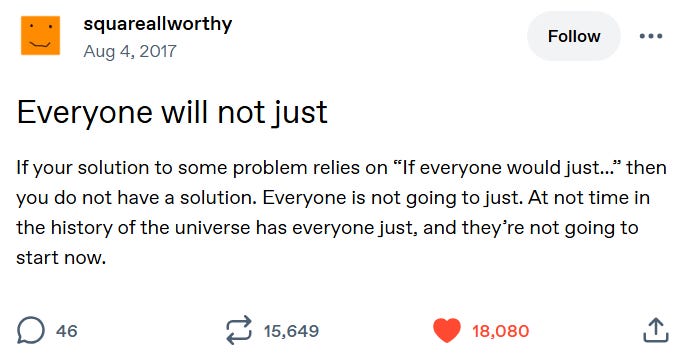
📣 “Everyone will not just”, Tumblr post by squareallworthy
My favourite social media site isn’t known for its insight, but this post has been a guiding light in my policy career. “If everyone would just behave rationally…” I have bad news for you.